"Personalization" sits on every trend list, usually as a one-liner: with data analysis, companies present tailored offers, which strengthens loyalty and buying intent. True. But that sentence hides the most important part. Because the same research that shows personalization lifts revenue also shows: done badly, it costs trust, subscriptions and customers. The difference isn't "whether," it's how — at which level, in which area, with what consent.
This article sorts "deep" personalization along two axes that get conflated constantly in practice: the level (how deep) and the area (where). Plus the honest flip side — when personalization tips into creepy — and the GDPR guardrails that, for a European mid-market company, decide between a fine and growth. And at the end: how to automate all of it, without an enterprise budget.
Personalization isn't a buzzword anymore — but it's no silver bullet either
The expectation is real and measurable. McKinsey finds that 71% of customers expect personalized interactions and 76% are frustrated when they're missing; companies that excel at personalization pull noticeably more revenue from it. Gartner expects that by 2028 around 60% of brands will use agentic AI for 1:1 interactions — AI that doesn't just deliver content, but tailors it autonomously.
At the same time, the reality check the glossy decks leave out: Gartner research from 2025 shows personalized campaigns turned negative for 53% of customers — those customers were 3.2x more likely to regret their purchase. And 38% will end the relationship when personalization feels "creepy." So personalization is not a dial you turn to "max." It's a dosage.
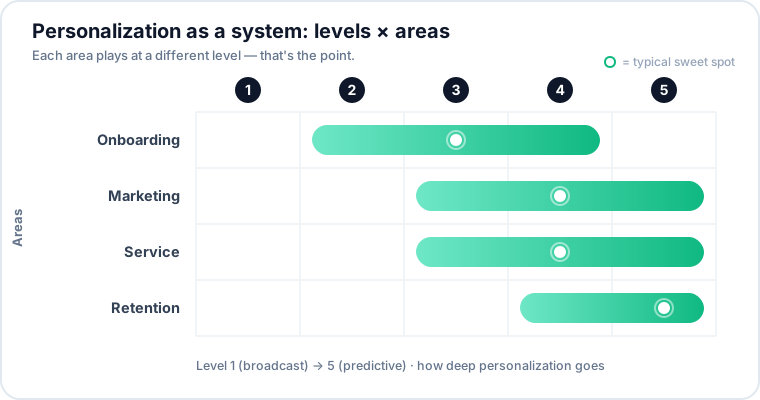
The two axes: levels × areas
Most personalization projects fail not on technology but on a confusion: they treat personalization as one thing. In reality it's two axes.
- The level describes how deep you personalize — from coarse segmentation to 1:1 outreach.
- The area describes where in the customer lifecycle you personalize — from onboarding to win-back.
The same person needs something different during onboarding than at churn risk. And not every level fits every consent state. Understand this matrix and you build personalization as a system — not a pile of isolated campaigns.
The five levels of personalization
Across analysts and vendors, a surprisingly stable five-rung ladder recurs (labels vary, the shape doesn't):
| Level | What happens | Example |
|---|---|---|
| 1 – Broadcast | One message for all, no personalization | Newsletter to the whole list |
| 2 – Segmentation / rules-based | Static rules and segments, triggered emails | "Customers in Munich get X" |
| 3 – Behavioral / dynamic | Real-time response to behavior, micro-segments | Cart abandonment triggers a fitting email |
| 4 – 1:1 individualization | A unique journey per person from a single customer view | Everyone sees different content, auto-optimized |
| 5 – Predictive / agentic | AI predicts the next best step and runs it | "Segment of one" in real time |
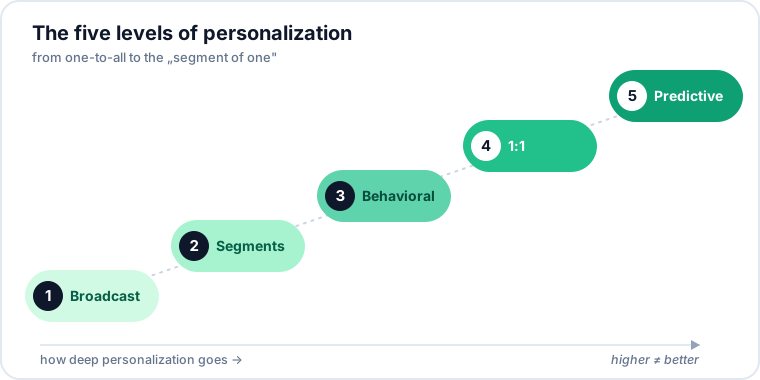
Crucial point: higher is not automatically better. Level 5 without clean consent and without a brake is exactly the recipe for "creepy." The art is choosing the right level for the context and the data you actually have.
The areas: where personalization works
On the other axis sit the application areas — the "different areas" real personalization runs across:
- Marketing — personalized emails, content and web experiences instead of one-to-all.
- E-commerce — product recommendations ("goes with this," "others also bought").
- Sales — next best action / next best offer: the most relevant next step or the right offer.
- Service — contextual, proactive help; the customer doesn't repeat their history.
- Onboarding / activation — role- and goal-based paths so new customers reach first value fast.
- Retention / win-back — on churn signals, a fitting recovery instead of a blanket discount.
One area is deliberately missing from the "definitely do this" list: personalized pricing. Technically possible, but the research is clear — individual prices are perceived as unfair, even by those who benefit, and damage trust. Personalize content, offers and timing. Not the price.
The line: when personalization tips into creepy
The "creepy line" — a term coined by former Google CEO Eric Schmidt — runs at a simple point: personalization gets unsettling when it seems to know more about someone than they consciously shared. Or simply when too much arrives.
Three brakes keep personalization on the right side of the line:
The GDPR guardrails that matter
This is where a marketing topic becomes a compliance topic — and exactly what many personalization projects miss until it gets expensive.
- Lawful basis: intrusive, cross-channel profiling generally needs consent (Art. 6(1)(a) GDPR), not just "legitimate interest." Direct marketing may be a legitimate interest — but only the weak form, and it always loses to an objection.
- Germany's §25 TDDDG (formerly TTDSG, renamed in 2024): any access to the device — cookies, tracking pixels, fingerprinting — needs prior consent, independent of your GDPR lawful basis.
- Art. 21(2) GDPR: against direct marketing including profiling there's an absolute right to object — no balancing, no exception. Whoever says "no" must drop out of personalization immediately and visibly.
- Art. 22 GDPR: if personalization tips into an automated decision with significant effect (creditworthiness, eligibility, access), a separate protective regime applies — then a human belongs in the loop. The CJEU's SCHUFA ruling (December 2023) clarified that even generating a score value can be such a "decision."
- Transparency (Art. 13/14): you must inform people understandably about automated profiling.
None of this is a reason to skip personalization. It's the reason to build it consent-based — which, conveniently, also makes it more trustworthy. To go deeper on the regulatory side, our guide to the 2026 compliance wall (EU AI Act + GDPR) shows how tightly AI use and data protection are now intertwined.
The cookie myth — and what actually holds
A correction, because it's wrong almost everywhere: third-party cookies are not "dead." Google reversed deprecation in Chrome twice; as of 2026 they still work there by default (Safari and Firefox block them). So the real driver for the shift isn't the cookie's death — it's GDPR, trust, and the simple fact that owned data is better.
The durable path is first-party and zero-party data:
- First-party data — observed behavior in your own channels, with consent.
- Zero-party data — what customers intentionally and proactively share: preferences, intentions, context (e.g. via a preference center).
Zero-party data is the most GDPR-aligned basis — explicit, consented, transparent — and at the same time the one that keeps personalization from feeling creepy. The privacy fix and the trust fix in one.
How the mid-market does this automatically
The most common mid-market mistake isn't the wrong level — it's imagining personalization as one big, expensive thing and therefore never starting. The data shows the gap clearly: large firms use AI in customer contact about twice as often as small ones. But the lever has shifted: generative AI makes 1:1 content affordable even for small audiences for the first time.
Because personalization is an automatable process, not an act of genius:
We built exactly these steps as a working showcase: the personalization engine — consent-based, with the four journeys and the built-in guardrail against "creepy." Which platform makes sense depends on your setup; the n8n vs. Make.com comparison helps with the choice.
Where to start — in 5 steps
Bottom line
Deep personalization isn't "more data, more channels, more messages." It's the right level in the right area with the right consent — plus a brake that stops relevance from turning into nuisance. The companies that get this treat personalization as a dosed, consent-based process: exactly the thing that automates well.
The biggest mistake isn't the wrong level. It's staying at "newsletter to everyone" out of fear of complexity — while the competition already speaks 1:1. If you want to try offline and cloud-free how these flows feel, the building blocks are in the Automation Showroom app.
This article is a practical orientation, not legal advice. For a binding assessment of your specific situation, consult a data protection or legal expert.